
Solapeña journal
What to see in Pallide and the Porma Reservoir from a rural house in León
A local guide to discovering Pallide and the Porma Reservoir: walks, landscape, plans with children, nearby routes and tips for choosing a rural house in León.
When someone is looking for a rural house in León , it's easy to end up comparing accommodations as if the entire province fit on a single small map. León is enormous. Sleeping near the capital, in El Bierzo, in Babia, or in the eastern mountains is a completely different experience. Therefore, before booking, we would ask a much more useful question than "which is the prettiest house?": what kind of scenery do you want to find when you open the door, and what do you feel like doing during your stay?
Solapeña is located in Pallide, a small village in the municipality of Reyero, next to the Porma Valley and within the Riaño and Mampodre Mountains. Here, the journey doesn't begin when you get in the car to go to a tourist attraction. It begins when you leave the house, hear the water, pass by the livestock, or see how the clouds transform the mountains in a matter of minutes.
Nearby lies the Porma Reservoir , one of the province's most impressive bodies of water. It's a place to explore at a leisurely pace, but also a gateway to Puebla de Lillo, the forests of the Regional Park, San Isidro, and Riaño. This combination makes Pallide an ideal base for a multi-day getaway: there are some major attractions that require a full day, and others that don't demand fixed schedules, entrance fees, or long drives.
This guide isn't meant to turn the valley into a checklist of places to tick off. We want to tell you what to see in Pallide and the Porma Reservoir , how to plan your visit depending on the time of year, and why this corner of the world might be the perfect fit if you're looking for rural tourism in León surrounded by authentic nature.
Pallide: a town to be experienced, not visited with a stopwatch
Pallide isn't a village set up like a tourist attraction. And that, for us, is precisely one of its virtues. You don't need to arrive with a list of monuments or look for five must-see places before lunch. The appeal lies in the whole: the houses, the meadows, the sound of the streams, the paths leading out of the village, and the feeling of being in a valley still connected to rural life.
Those who come from a city usually need a few hours to adjust. At first, it seems like "nothing's happening." Then the details begin to appear: the early morning light on the hillsides, a conversation by a doorway, cows returning from pasture, the changing color of the sky before it rains, or that silence of the night that is so rarely found anymore.
A stroll through the village is the best way to begin your stay. There's no need to follow a specific route. Walk slowly, respect the houses and farms, and observe how they have been traditionally built to withstand the cold, the rain, and the demands of livestock farming. Pallide can't be truly understood from a car; it's best experienced on foot.
Water as part of the everyday landscape
The Reyero Valley is crisscrossed by streams that eventually flow into the Porma River. Around Pallide, there are small rivulets, bridges, riverside vegetation, and secluded spots where the water is heard before it is seen. Depending on the season, a calm stream can swell with the snowmelt or after several days of rain.
This changeable nature of the terrain requires caution. A path that seems easy in summer may not be so in spring. Do not cross swollen streams, do not enter private property to approach a waterfall, and ask for directions if you have any doubts about a trail. In the mountains, local and public areas are not always distinguishable using a route-finding app.
Walking from home without seeking a great feat
One of the things our guests appreciate most is being able to spend a morning walking without having to organize a full expedition. Traditional paths and trails lead from the area around the village, offering panoramic views of the valley. Not all of them are marked as official trails, and some cross areas used for livestock grazing, so it's advisable to plan your walk accordingly, close any gates you find locked, and keep dogs under control.
For a first outing, we recommend something very simple: choose a clear path, walk to an agreed-upon point, and return the same way. With children, this format works better than promising a circular route whose end no one knows. It also allows you to turn back if the weather changes, mud appears, or the group decides they'd rather sit and admire the scenery.
You don't need to climb a summit to feel the mountains. Sometimes an hour's walk from a rural house in Pallide leaves a clearer memory than a whole day getting in and out of the car.
The Porma Reservoir: water, mountain and memory
The Porma Reservoir, whose dam is named after the engineer and writer Juan Benet, came into service in 1968. The Duero River Basin Authority ranks it as the second most important reservoir in the province of León, after Riaño, and it has an approximate capacity of 317.8 cubic hectometers.
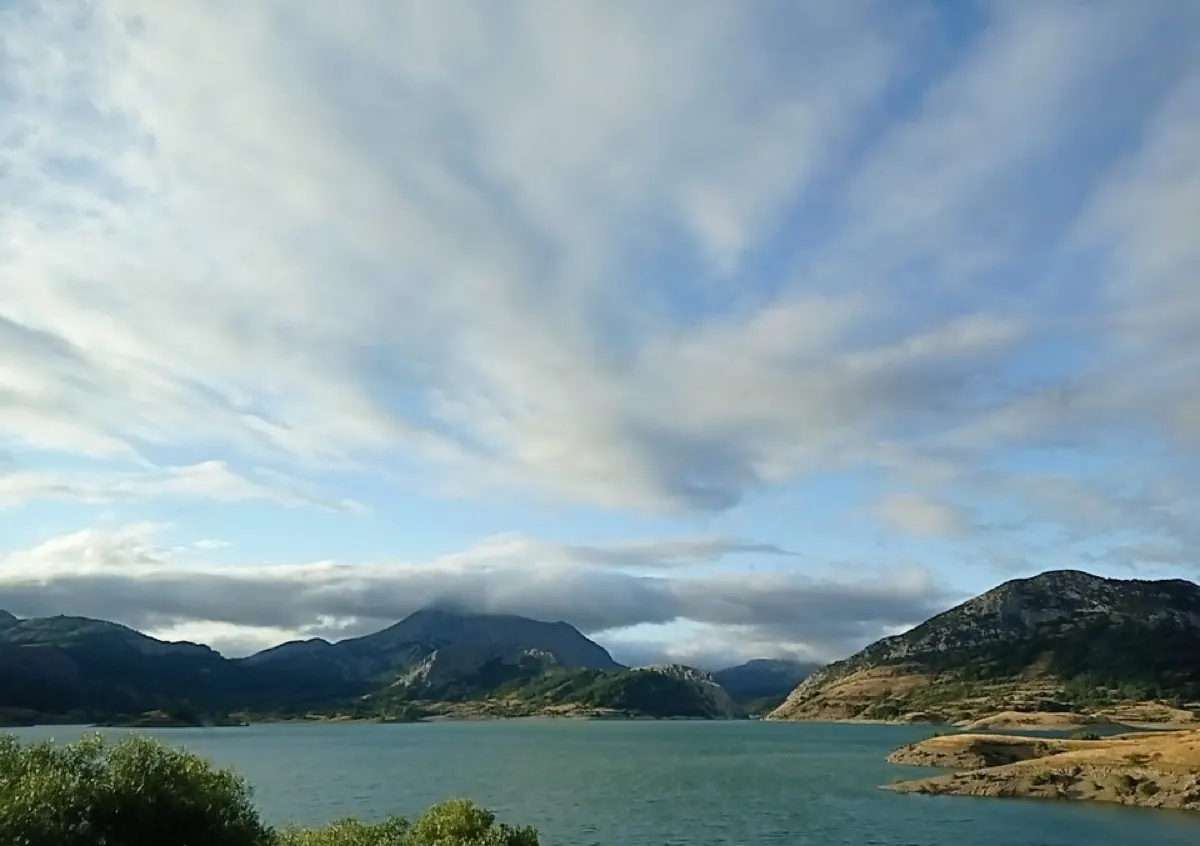
The numbers help you understand its scale, but they don't explain what it feels like to see it. The water fills a wide valley and winds its way through mountains, forests, and former farmland. Depending on the reservoir's level, the wind, and the light, the landscape looks different every time. There are days of clear blue skies, mornings when fog obscures the shore, and late summers when the receding water reveals areas that have remained submerged for months.
Nor is it an empty landscape. The construction of the reservoir profoundly transformed life in the valley and led to the disappearance of villages like Vegamián, Armada, Campillo, Ferreras, Lodares, and Quintanilla. Other settlements were expropriated. To speak of the Porma merely as a beautiful photograph would leave out an essential part of its history.
If you're interested in understanding that history, visit the reservoir with plenty of time and read beforehand about the villages that were submerged beneath its waters. The landscape gains depth when we know that beneath that surface there were houses, roads, orchards, and entire lives. It's one of those places where nature, engineering, and human memory are inextricably linked.
How to get to know the Porma Reservoir without just taking a picture
The Porma reservoir doesn't have a single viewpoint that offers a panoramic view. It unfolds gradually from the road, from designated trails, and from the surrounding villages. We recommend choosing a few viewpoints and lingering at each one, rather than constantly stopping along the roadside.
Before stopping, check that there is a safe and permitted space. Do not block entrances to properties, forest tracks, or service roads. The road may be narrow, and taking a photograph is no excuse for leaving your car where it obstructs visibility. If you are traveling in several vehicles, it is much more convenient to meet up beforehand and continue in one or two cars.
The water level changes throughout the year because the reservoir serves a regulatory function. Therefore, a riverbank, a peninsula, or a view seen in an old photograph may look different during your visit. This variation doesn't mean "the place is worse"; it's part of the Porma River's natural functioning and character.
The signposted route of the Porma Reservoir
The Castile and León Tourism Portal includes a circular route around the Porma Reservoir, approximately 10.2 kilometers long, with a medium difficulty level and an estimated duration of just over three hours. It's a useful reference for those who want to turn enjoying the scenery into a hike, but this information doesn't replace experiencing it firsthand.
Before setting out, check the official route information, the forecast, the current status of the trail, and any warnings or restrictions. Bring water, appropriate footwear, and a downloaded route map. Cell phone coverage can be unreliable, and the estimated time can vary significantly if the terrain is wet, you're traveling with children, or you stop to take photos.
If you're not used to hiking in the mountains, there's no obligation to complete ten kilometers. A shorter, safer walk is still an excellent way to explore the reservoir.
What to do in Pallide and Porma during a rural getaway
Stroll and observe
It's the simplest plan and one of the best. Choose a route suitable for the group, set off at a leisurely pace, and pay attention to changes in the terrain. In spring there may be mud and swollen streams; in summer, more sun than it seems; in autumn, damp leaves; and in winter, ice even if it hasn't snowed in the village.
A small backpack with water, a warm layer, some food, and a charged mobile phone is enough for a short walk. For longer hikes, you'll need a map, appropriate equipment, and planning.
Explore the area by bicycle
The roads and trails attract both road and mountain bikers, although the elevation changes, surface conditions, and weather can make even a short ride challenging. Plan your route, respect fences and livestock uses, and don't rely on downloaded routes without knowing their origin. Solapeña has bike storage; you can find more options on our page about experiences in the mountains of León .
Fishing, always keeping the regulations in mind
The Porma River is closely linked to fishing, but licenses, seasons, sections, methods, and baits depend on current regulations. Consult the fishing sections and plans provided by the Regional Government of Castile and León and don't rely on an old forum or the previous season. If you're unfamiliar with the area, consider going with a professional and always respect private property and access points.
Water activities
There may be options for active tourism, but not every riverbank should be considered a free recreational area. If you want to kayak or canoe, check the regulations and go with a licensed company. Water level, wind, and temperature matter; the water can be cold even in summer. With children, a life jacket is never a substitute for supervision.
Read, cook, and relax
Pallide is also a great place to stay. Cooking, reading, playing games, or lingering over a meal are all part of the experience. Having a whole house allows you to adapt your day to the weather and how tired you are: if it rains, your stay isn't ruined; if the children need to stop, there's no need to keep them in the car.
What to see near Pallide besides the reservoir
Puebla de Lillo and the Park House
Puebla de Lillo is a natural reference point for understanding the upper Porma Valley. There you'll find the Porma Valley Park Visitor Center , housed in the old school building. Its exhibits interpret the landscapes of the Regional Park through environments linked to the river, the forest, and the mountain peaks, as well as explaining the adaptations of species such as the Pyrenean chamois, the Cantabrian capercaillie, and the alpine newt.
It's a particularly useful visit at the beginning of your trip because it allows you to ask about marked trails, viewpoints, and conditions. It also works well with children or on a day with unsettled weather. Opening hours vary throughout the year, so it's best to check them before you travel.
The Riaño and Mampodre Mountain Regional Park
Pallide is located in a high mountain area encompassing the headwaters of the Esla, Porma, and Cea rivers. The Riaño and Mampodre Mountain Regional Park features forests, meadows, rocky outcrops, and glacial lakes, as well as a network of trails of varying difficulty.
Don't choose a route just because the photo looks spectacular. Check its length, elevation gain, terrain, and signage. The same path can be easy on a dry day but challenging in fog, snow, or a storm. If you want to explore a forest or a sensitive area, find out about any restrictions and whether you need a permit or a guided tour.
On the Solapeña environment page we have gathered some of the experiences that can be combined from the house.
San Isidro
The San Isidro ski resort makes Pallide a potential base for combining exploring the valley with days on the slopes. We're not right on the slopes: under normal conditions, allow approximately 45 to 50 minutes for the drive, and even longer if there's snow, ice, or traffic. This option is better suited to stays of several nights than trips where the only priority is being first on the lift.
If you're traveling in a group to ski, we've prepared a specific guide on accommodation near San Isidro for groups , with advice on cars, equipment, lessons and organization.
Riaño
Riaño deserves a day trip of its own. From Pallide, you can plan a day trip to discover the reservoir, the viewpoints, the town, and perhaps a specific activity. The journey itself is part of the scenery, but we don't recommend trying to visit Riaño, San Isidro, Puebla de Lillo, and the Porma River all in the same day. Seeing more places doesn't always mean getting to know them better.
Our guide to what to see near Riaño from a rural house helps you choose viewpoints, routes and plans with children without turning the day into a race.
Pallide and the Porma Reservoir with children
A rural getaway with children works best when the plan has some flexibility. A one-kilometer walk can take an hour if you encounter footprints, stones, water, or livestock. Instead of trying to make them walk like little adults, suggest goals they can understand: finding three colors in the leaves, listening for birds, locating water, or each taking a photograph.
For going out, it's advisable to bring:
- Shoes that can get dirty and a change of clothes.
- A waterproof layer even if the forecast seems stable.
- Water and some food.
- Year-round sun protection.
- A bag to take away the waste.
- A small first-aid kit for longer excursions.
Near the reservoir and any waterways, maintain constant supervision. Banks can be unstable, slippery, or change with the water level. Do not encourage children to climb down embankments to get closer.
Upon returning to Solapeña, the children’s space offers a complete change of pace. There are games for different age groups and a chalkboard where we keep drawings and notes left by previous guests. For many families, it's not just a backup plan in case of rain, but one of the spaces their children remember most fondly.
What is the best time to stay near the Porma River?
Spring: water, green, and changing weather
Spring brings back the flow of streams and transforms meadows, but it demands flexibility: it can dawn clear, rain at midday, and leave mud for days. It's a good time to combine short walks, a visit to the Park Center, and time at your accommodation. Don't plan water crossings based on summer photos.
Summer: long days and cool nights
Summer is the perfect time for early morning walks and to save the last light for the reservoir. The mountains don't guarantee warm nights, so bring warm clothing and sun protection. During your vacation, it's advisable to book restaurants and activities in advance, avoid any fire hazards, and respect all restrictions.
Autumn: forest, color and a special light
For us, autumn is one of the best times: the forest changes, the tourist crowds slow down, and the light is special. The wet leaves are slippery, and the days get shorter, so set out early and return before you rush through your day.
Winter: silence, ice, and flexible plans
With snow, Pallide is completely transformed. Check AEMET (the Spanish State Meteorological Agency) for weather forecasts and road conditions, carry compatible snow chains or appropriate tires, and never start a route without knowing the conditions. Even without visible snow, there may be ice. A short walk in good footwear is more sensible than forcing yourself to stick to a plan prepared weeks in advance.
How to choose a rural house in León to visit the Porma
Location is important, but it's not everything. If you're comparing rural accommodations in León , check out factors that truly affect your stay:
- Authorized capacity and actual bed distribution.
- Number of bathrooms in relation to the group.
- Kitchen and dining room adapted to the size of the house.
- Space for bicycles, boots or sports equipment.
- Parking and access in winter.
- Pet policy.
- Options for children and rainy days.
- Actual distances to the plans that interest you.
- Booking conditions and check-in and check-out times.
One house might be a few kilometers closer to a viewpoint and be uncomfortable for eight people. Another might require a longer car, but allow for a different plan each day. Think about the entire trip, not just the distance to a point on the map.
The houses of Solapeña in Pallide
Solapeña comprises three independent houses within the same rural complex. This allows accommodation for couples and small families as well as larger groups, while maintaining private spaces.
Arianes House: up to 10 people
Casa Arianes has five double bedrooms and five private bathrooms. Its living room, dining room, and open-plan kitchen form the largest common area of the three houses. It's the perfect choice for a large family or a group of friends who want to share the accommodation without having to constantly organize bathroom shifts.
Acebo House: up to 6 people
Casa Acebo has three bedrooms, two bathrooms, a separate kitchen, a pellet stove, and a private garden with a porch. It's especially well-suited for a family or a medium-sized group who appreciate having their own outdoor space.
Casa Roble: up to 4 people
Casa Roble offers two bedrooms, a living room with an open-plan kitchen, and a single-story layout. It is accessible for people with reduced mobility, although we recommend explaining your specific needs before booking so we can verify every detail.
The houses can be combined, subject to availability, for groups of up to twenty people. They are separate dwellings: adding beds does not automatically create a single room for twenty. If you are traveling in a group, please tell us how you would like to organize meals and gatherings to confirm that the layout suits your needs. Our guide to rural houses for groups in León covers these topics in more detail.
Practical tips before traveling to Pallide
Do some basic shopping before you arrive, download maps, and share your house's location: services aren't always available, and coverage can vary. Check the weather forecast, activity status, and sunset times. Travel with enough fuel, and in winter, keep snow chains and gloves within easy reach. Confirm tours, activities, and restaurants directly; a schedule posted months ago may have changed.
Frequently asked questions about Pallide, the Porma and rural accommodation
Where is Pallide?
Pallide belongs to the municipality of Reyero in León, in the eastern mountains of the province and near the Porma Valley. It is a small village from which you can easily combine a visit to the reservoir, Puebla de Lillo, the Regional Park, San Isidro, and Riaño during a stay of several days.
Is it possible to see the Porma Reservoir in a single day?
Yes. A day trip allows you to see a few different viewpoints, take a stroll, and combine it with a visit to Pallide or Puebla de Lillo. Don't try to circle the entire area, stopping at every point. Choosing two or three places usually offers a much better experience.
Are there hiking trails along the reservoir?
There is a circular route included on the Castilla y León Tourism Portal, approximately 10.2 kilometers long and of medium difficulty. There are also trails within the Regional Park. Always check official information and current conditions before setting out.
Is it a suitable destination for traveling with children?
Yes, if distances are adjusted and extra vigilance is maintained near the water. Pallide is suitable for short walks, and Solapeña has a play area to continue the day's activities upon returning. The Puebla de Lillo Park Visitor Center is also a good introduction to the area's ecosystems.
Can you bring a dog?
At Solapeña, we welcome pets under the responsibility of their owners. Outside the house, owners must respect the rules of each area, livestock, wildlife, and private property. Keep your dog on a leash and do not assume that a secluded path allows you to let your dog off-leash.
Can I swim or sail in the Porma Reservoir?
Not every point on the shoreline should be treated as a beach or pier. Conditions, access, and permits may vary. For water activities, consult current regulations and use authorized companies. Cold water, wind, and changes in water level require caution.
How many nights should I book?
To explore Pallide and the reservoir at a leisurely pace, two nights are a good starting point. Three or four nights offer much more flexibility to add Puebla de Lillo, a hiking route, San Isidro or Riaño, and to change the order if the weather isn't ideal.
Is Solapeña a rural house near León city?
Solapeña is located in the province of León, in the heart of the eastern mountains, not near the capital. If your priority is visiting the city daily, it wouldn't be the most convenient location. However, if you're looking for nature, reservoirs, villages, and mountain activities, this trip is precisely what will put you in the landscape you've come to explore.
Which house in Solapeña should we choose?
It depends on the number of people and the layout you require. Roble accommodates up to four guests, Acebo up to six, and Arianes up to ten. For larger groups, several houses can be combined, subject to availability. Please check the listings for our rural houses in Pallide or contact us before booking.
A rural house in León where the surroundings begin at the door.
Pallide doesn't compete to offer an endless array of attractions. It offers something harder to find: time, scenery, and a vantage point from which each day can have a different rhythm. You can stroll around the village, spend a day at the Porma Reservoir, explore the Regional Park, head up to San Isidro, or reserve a whole day for Riaño.
And you can also do nothing extraordinary. Have a late breakfast, watch the rain, cook together, listen to the children play, and go for a walk when the light returns. For us, that too is experiencing the mountains of León.
If you're looking for a rural house in León near the Porma Reservoir , check availability and prices or contact us through our contact page . Tell us how many people are coming, the dates, and what kind of activities you'd like to do. We'll help you choose the perfect house and plan your getaway honestly, so that your trip isn't just about getting to Pallide, but about truly experiencing it.